Shopping cart
Your cart empty!

Your cart empty!

Join 10k+ people to get notified about new posts, news and tips.
Do not worry we don't spam!
Terms of use dolor sit amet consectetur, adipisicing elit. Recusandae provident ullam aperiam quo ad non corrupti sit vel quam repellat ipsa quod sed, repellendus adipisci, ducimus ea modi odio assumenda.
Lorem ipsum dolor sit amet consectetur adipisicing elit. Sequi, cum esse possimus officiis amet ea voluptatibus libero! Dolorum assumenda esse, deserunt ipsum ad iusto! Praesentium error nobis tenetur at, quis nostrum facere excepturi architecto totam.
Lorem ipsum dolor sit amet consectetur adipisicing elit. Inventore, soluta alias eaque modi ipsum sint iusto fugiat vero velit rerum.
Sequi, cum esse possimus officiis amet ea voluptatibus libero! Dolorum assumenda esse, deserunt ipsum ad iusto! Praesentium error nobis tenetur at, quis nostrum facere excepturi architecto totam.
Lorem ipsum dolor sit amet consectetur adipisicing elit. Inventore, soluta alias eaque modi ipsum sint iusto fugiat vero velit rerum.
Dolor sit amet consectetur adipisicing elit. Sequi, cum esse possimus officiis amet ea voluptatibus libero! Dolorum assumenda esse, deserunt ipsum ad iusto! Praesentium error nobis tenetur at, quis nostrum facere excepturi architecto totam.
Lorem ipsum dolor sit amet consectetur adipisicing elit. Inventore, soluta alias eaque modi ipsum sint iusto fugiat vero velit rerum.
Sit amet consectetur adipisicing elit. Sequi, cum esse possimus officiis amet ea voluptatibus libero! Dolorum assumenda esse, deserunt ipsum ad iusto! Praesentium error nobis tenetur at, quis nostrum facere excepturi architecto totam.
Lorem ipsum dolor sit amet consectetur adipisicing elit. Inventore, soluta alias eaque modi ipsum sint iusto fugiat vero velit rerum.
Do you agree to our terms? Sign up
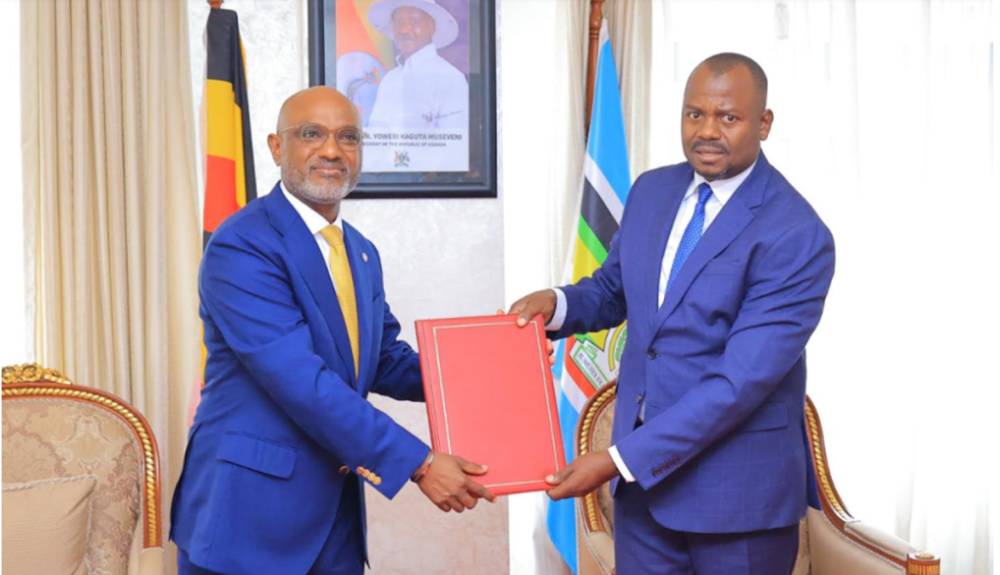
On First Avenue in Manhattan, the United Nations headquarters—frequently called the "Glass Palace"—serves as the ultimate theater of international power.
For diplomats who walk its marble corridors, success requires far more than oratorical flair; it demands an ironclad command of procedural rules, deep-rooted networks across diverse geopolitical blocs, and the stamina to navigate high-stakes, closed-door negotiations.
For nearly a decade, Ambassador Dr. Adonia Ayebare commanded this arena as Uganda’s Permanent Representative to the United Nations.
His tenure in New York was not merely a diplomatic posting; it was the definitive proving ground where Kampala’s modern foreign policy transitioned from a regional voice into a formidable global presence, directly supporting President Yoweri Museveni’s broader vision of anchoring Uganda at the center of international affairs.
Before taking the helm of Uganda’s UN mission in May 2017, Ayebare spent years mastering the intricate mechanics linking continental African diplomacy with global security architecture.
From January 2013 to March 2017, he served as the Senior Adviser on Peace and Security at the African Union’s Permanent Observer Mission to the United Nations in New York City.
In this dual-lens role, Ayebare sat at the intersection of two vast bureaucracies:
Translating the African Union’s peace and security mandates into actionable agendas for the UN Security Council.
Advocating for African-led solutions to continental conflicts, ensuring that Western-dominated security frameworks respected regional sovereignty and localized context.
This deep institutional grounding equipped him with a rare fluency in international law and crisis management, preparing him for the intense geopolitical friction that characterized his subsequent years as Uganda's chief envoy.
When Ayebare presented his credentials as Uganda’s Permanent Representative, he stepped into a post that required both administrative modernization and aggressive diplomatic positioning.
Over his distinguished tenure running through 2025/2026, he redefined how a mid-sized developing nation could punch far above its weight class.
Rather than reacting defensively to international pressures or donor conditionalities, Ayebare’s mission adopted a proactive posture.
He cultivated robust relationships across the UN Security Council, positioning Uganda not as a passive petitioner, but as an indispensable partner in regional stabilization, peacekeeping operations, and refugee protection.
His office became a trusted hub for back-channel diplomacy, where Western ambassadors, Asian economic powerhouses, and African delegates found a reliable interlocutor who understood both the granular realities of the Great Lakes region and the high-altitude politics of the UN Secretariat.
One of the defining chapters of Ayebare’s New York tenure occurred when Uganda assumed major leadership roles within the developing world, including coordinating positions for the Group of 77 and China alongside Uganda's chairmanship of the Non-Aligned Movement (NAM).
Coordinating the disparate interests of a 120-nation bloc within the complex machinery of the United Nations is an immense logistical and political undertaking.
From his base in New York, Ayebare played a central role in:
Aligning developing nations around unified stances on international financial reform, climate resilience, and sovereignty.
Shielding developing economies from being coerced into polarized blocs amidst escalating rivalries between global superpowers.
Championing the Global South's environmental agenda, earning him widespread international recognition, including the African Climate Diplomacy and Policy Leadership Award.
Ayebare’s decade-long immersion in New York multilateralism ultimately laid the groundwork for his elevation to the highest echelons of state leadership in Kampala.
The mastery of coalition diplomacy, international trade frameworks, and global governance that he honed inside the Glass Palace provided the exact skill set required to steer Uganda’s foreign ministry.
As he transitioned from New York to his swearing-in as Uganda's Minister of Foreign Affairs at State House Entebbe, Ayebare left behind a transformed legacy at the United Nations.
He proved that with intellectual rigor, sharp strategic foresight, and unwavering commitment to national interests, a developing nation could make its voice decisive in the most powerful halls on earth.
In the next chapter of our series, "Quiet Diplomacy: How Ayebare Masterminded Regional Peace Talks," we examine how the veteran diplomat applied his back-channel negotiation skills to resolve explosive regional crises, focusing on his masterclass in mediation during delicate high-level talks in the Great Lakes.