Shopping cart
Your cart empty!

Your cart empty!

Join 10k+ people to get notified about new posts, news and tips.
Do not worry we don't spam!
Terms of use dolor sit amet consectetur, adipisicing elit. Recusandae provident ullam aperiam quo ad non corrupti sit vel quam repellat ipsa quod sed, repellendus adipisci, ducimus ea modi odio assumenda.
Lorem ipsum dolor sit amet consectetur adipisicing elit. Sequi, cum esse possimus officiis amet ea voluptatibus libero! Dolorum assumenda esse, deserunt ipsum ad iusto! Praesentium error nobis tenetur at, quis nostrum facere excepturi architecto totam.
Lorem ipsum dolor sit amet consectetur adipisicing elit. Inventore, soluta alias eaque modi ipsum sint iusto fugiat vero velit rerum.
Sequi, cum esse possimus officiis amet ea voluptatibus libero! Dolorum assumenda esse, deserunt ipsum ad iusto! Praesentium error nobis tenetur at, quis nostrum facere excepturi architecto totam.
Lorem ipsum dolor sit amet consectetur adipisicing elit. Inventore, soluta alias eaque modi ipsum sint iusto fugiat vero velit rerum.
Dolor sit amet consectetur adipisicing elit. Sequi, cum esse possimus officiis amet ea voluptatibus libero! Dolorum assumenda esse, deserunt ipsum ad iusto! Praesentium error nobis tenetur at, quis nostrum facere excepturi architecto totam.
Lorem ipsum dolor sit amet consectetur adipisicing elit. Inventore, soluta alias eaque modi ipsum sint iusto fugiat vero velit rerum.
Sit amet consectetur adipisicing elit. Sequi, cum esse possimus officiis amet ea voluptatibus libero! Dolorum assumenda esse, deserunt ipsum ad iusto! Praesentium error nobis tenetur at, quis nostrum facere excepturi architecto totam.
Lorem ipsum dolor sit amet consectetur adipisicing elit. Inventore, soluta alias eaque modi ipsum sint iusto fugiat vero velit rerum.
Do you agree to our terms? Sign up
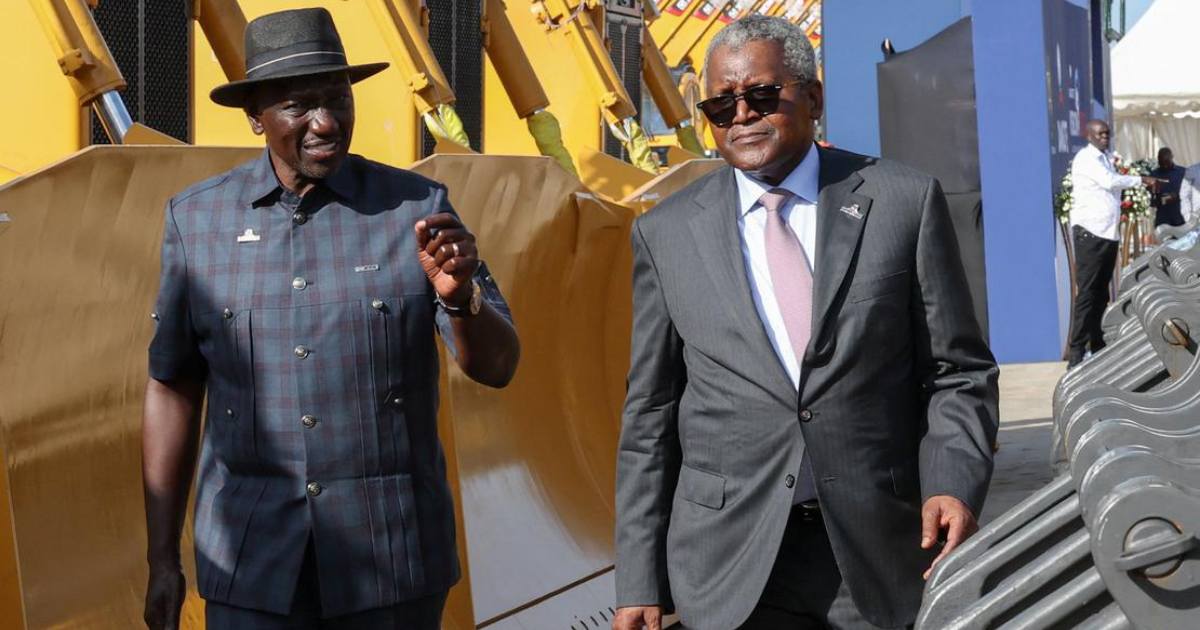
The groundbreaking of Aliko Dangote’s $16 billion petroleum refinery in Lamu, Kenya, has opened a new chapter in Africa’s industrialisation drive, positioning East Africa within a wider $50 billion investment strategy aimed at expanding African manufacturing, processing and regional industrial integration.
The proposed Dangote East Africa Petroleum Refinery is designed to process about 700,000 barrels of crude oil daily, creating capacity to supply Kenya and neighbouring markets including Uganda, Tanzania, South Sudan, the Democratic Republic of Congo and Zambia.
The September 30 groundbreaking brought together regional leaders who presented the project as an opportunity extending beyond petroleum. Uganda’s President Yoweri Museveni backed greater African value addition and regional integration, while discussions included opportunities for neighbouring economies to participate in the development.
Lamu is expected to become considerably more than a refinery. Kenya’s government says the development will include a 1,000-megawatt power plant, fertiliser and chemical manufacturing, creating the foundations of an integrated industrial complex around the strategically positioned Indian Ocean port.
Its location could further connect production with the Lamu Port-South Sudan-Ethiopia Transport corridor, potentially combining energy, manufacturing, logistics and regional trade infrastructure. The project consequently provides an early indication of the broader industrial architecture Dangote intends to develop across Africa.
Behind Lamu sits an even larger ambition. Dangote plans to invest as much as $50 billion across Africa by 2030, targeting energy, manufacturing, mining, ports and other strategic sectors following approximately $25 billion invested during the group’s preceding five-year capital programme.
The scale suggests something beyond conventional corporate expansion. Dangote is increasingly pursuing a continental industrial strategy based on processing African resources locally, manufacturing at massive scale, developing supporting infrastructure and using regional markets to create sufficient demand for globally competitive African production.
At the centre of that strategy is one of Africa’s longstanding economic weaknesses. The continent exports enormous quantities of minerals, agricultural commodities and energy resources while frequently importing higher-value products manufactured elsewhere from those same resources.
Dangote argues that this structure must change. Speaking in Lamu, he called for more African resources to be processed within the continent, envisioning African ports increasingly sending manufactured products abroad rather than primarily exporting commodities for industrial processing elsewhere.
That philosophy already connects the group’s investments in cement, petroleum refining, petrochemicals and fertiliser. Instead of treating Africa primarily as a source of commodities, the strategy attempts to capture additional value through processing, manufacturing, distribution and exports.
Scale is fundamental to the model. Rather than constructing relatively small plants serving individual countries, Dangote has increasingly pursued mega-industrial facilities capable of supplying multiple African markets, competing against imports and eventually positioning African-manufactured products within international markets.
Nigeria’s Dangote Petroleum Refinery established the most visible example. The mega-project was developed partly to reduce Nigeria’s dependence on imported refined petroleum products while creating refining and petrochemical capacity capable of serving domestic and international customers.
Lamu now appears designed to extend that industrial philosophy into East Africa. Its refinery, power generation, fertiliser and chemical facilities could create an anchor around which engineering, logistics, construction, storage, transportation, maintenance and other supporting industries develop.
This is where Dangote’s strategy potentially becomes more consequential than individual factories. Large anchor investments can generate industrial clusters, attracting suppliers and service businesses while creating demand for infrastructure, technical expertise and specialised labour.
Dangote has also discussed establishing training capacity around the Lamu development. Connecting industrial investment with skills development could help produce the engineers, technicians and operators required to sustain increasingly sophisticated African manufacturing systems.
The emerging architecture therefore combines resources, processing, energy, infrastructure, logistics, skills and markets. Each component reinforces the others, potentially transforming isolated investments into interconnected industrial ecosystems.
Regional integration provides another critical element. A 700,000-barrel refinery becomes more economically significant when its addressable market extends beyond Kenya into Uganda, Tanzania, South Sudan, the DRC, Zambia and other neighbouring economies.
This turns regional economic integration into an industrial instrument. Instead of every African country attempting to develop complete industrial systems independently, large production centres can specialise while accessing wider continental markets through improved infrastructure and trade arrangements.
Dangote’s $50 billion programme extends the strategy beyond petroleum. Mining, manufacturing, ports and energy are among the announced priorities, complementing established businesses in cement, fertiliser, refining and petrochemicals.
Together, they reveal a relatively coherent industrial sequence:
African resources → African processing → industrial clusters → regional markets → African capital → global exports.
Ownership could become another important component. Dangote has indicated that African investors should increasingly participate in his businesses through capital markets, potentially connecting continental industrial expansion with broader African ownership of productive assets.
That proposition expands Africa’s industrialisation debate beyond foreign direct investment. International capital, technology and expertise remain essential, but African institutional investors, businesses and private capital could increasingly participate in building multinational enterprises operating across continental markets.
The strategy nevertheless carries considerable execution risks. Mega-industrial developments require enormous financing, reliable infrastructure, regulatory certainty, skilled labour and sustained political coordination. Land rights, environmental safeguards and community interests can also determine whether large projects translate into sustainable economic development.
The $50 billion should consequently be understood as an announced investment programme rather than money already deployed. Financing conditions, approvals, construction performance, commodity markets and political cooperation will ultimately determine how much of the programme materialises by 2030.
Yet Lamu illustrates why the strategy matters. Dangote is effectively testing whether African industrialisation can move beyond fragmented national economies and operate at continental scale, connecting resources and production with regional consumers and international markets.
If successful, the model could demonstrate that African integration is not simply about removing trade barriers. It can provide the economic scale required to build globally competitive factories, infrastructure networks and African multinational corporations.
Dangote’s emerging masterplan ultimately rests on a straightforward proposition: process more in Africa, manufacture more in Africa, trade more within Africa and export more African-made products to the world.
Lamu is therefore more than another refinery project. It represents an important test of whether African capital, resources, infrastructure and integrated regional markets can be combined into industrial ecosystems capable of competing globally — and accelerating Africa’s transition from a commodity-producing continent towards an industrial economy.