Shopping cart
Your cart empty!

Your cart empty!

Join 10k+ people to get notified about new posts, news and tips.
Do not worry we don't spam!
Terms of use dolor sit amet consectetur, adipisicing elit. Recusandae provident ullam aperiam quo ad non corrupti sit vel quam repellat ipsa quod sed, repellendus adipisci, ducimus ea modi odio assumenda.
Lorem ipsum dolor sit amet consectetur adipisicing elit. Sequi, cum esse possimus officiis amet ea voluptatibus libero! Dolorum assumenda esse, deserunt ipsum ad iusto! Praesentium error nobis tenetur at, quis nostrum facere excepturi architecto totam.
Lorem ipsum dolor sit amet consectetur adipisicing elit. Inventore, soluta alias eaque modi ipsum sint iusto fugiat vero velit rerum.
Sequi, cum esse possimus officiis amet ea voluptatibus libero! Dolorum assumenda esse, deserunt ipsum ad iusto! Praesentium error nobis tenetur at, quis nostrum facere excepturi architecto totam.
Lorem ipsum dolor sit amet consectetur adipisicing elit. Inventore, soluta alias eaque modi ipsum sint iusto fugiat vero velit rerum.
Dolor sit amet consectetur adipisicing elit. Sequi, cum esse possimus officiis amet ea voluptatibus libero! Dolorum assumenda esse, deserunt ipsum ad iusto! Praesentium error nobis tenetur at, quis nostrum facere excepturi architecto totam.
Lorem ipsum dolor sit amet consectetur adipisicing elit. Inventore, soluta alias eaque modi ipsum sint iusto fugiat vero velit rerum.
Sit amet consectetur adipisicing elit. Sequi, cum esse possimus officiis amet ea voluptatibus libero! Dolorum assumenda esse, deserunt ipsum ad iusto! Praesentium error nobis tenetur at, quis nostrum facere excepturi architecto totam.
Lorem ipsum dolor sit amet consectetur adipisicing elit. Inventore, soluta alias eaque modi ipsum sint iusto fugiat vero velit rerum.
Do you agree to our terms? Sign up
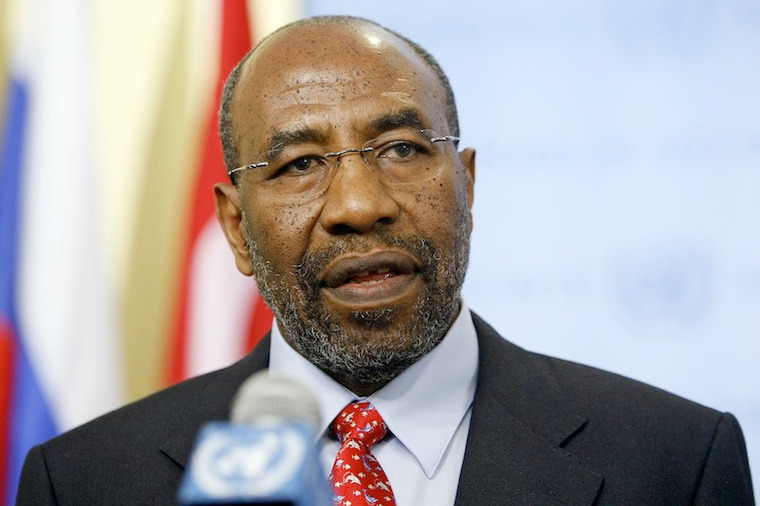
When Uganda placed Ambassador Olara Otunnu into the race for United Nations Secretary-General on 24 July 2026, it did more than add another name to an already crowded field. It handed former Prime Minister Dr. Ruhakana Rugunda a diplomatic assignment measured not in months, but in weeks.
Otunnu entered the contest after the other six candidates had already participated in the General Assembly's public engagement process. The UN's own selection record confirms his nomination on 24 July, making him the seventh declared candidate.
By then, the diplomatic machinery was already moving.
On 30 July, the Security Council conducted its first informal straw poll. Rebeca Grynspan of Costa Rica emerged with 10 "encourage" votes, followed by Carolyn Rodrigues-Birkett of Guyana with nine and Rafael Grossi of Argentina with seven. The poll was non-binding, but it gave the race its first measurable political contours.
For Rugunda, Uganda's envoy to the world, the problem is therefore brutally simple: how do you build momentum for a late entrant when the diplomatic race has already begun to sort itself out?
The answer may lie not in trying to imitate the campaigns that came before Otunnu, but in exploiting something none of the other candidates possesses—the history of having helped shape the very process through which a Secretary-General is chosen.
In 1981, Otunnu was a 31-year-old Ugandan Permanent Representative to the United Nations and President of the Security Council. A prolonged contest for the Secretary-Generalship had produced repeated deadlock. Otunnu proposed an informal system in which Council members could privately signal whether they encouraged or discouraged individual candidates.
The procedure helped break the stalemate that eventually produced Javier Pérez de Cuéllar as the compromise candidate. The mechanism would become known as the "Otunnu Formula" and was subsequently adapted in later Secretary-General selections.
The historical symmetry is extraordinary.
The young African diplomat who helped the Security Council find a way through a leadership impasse is now competing for the leadership of the institution itself.
The UN's historical record makes the connection unusually concrete. The resolution recommending Pérez de Cuéllar was signed by Olara A. Otunnu, then President of the Security Council.
More than four decades later, the formula he helped introduce is again being used—and this time his own name is on the ballot.
The Otunnu candidature is not built solely on an intriguing historical coincidence.
His diplomatic career took him from Uganda's Permanent Mission to the United Nations into senior UN leadership. He later served as UN Under-Secretary-General and Special Representative of the Secretary-General for Children and Armed Conflict, making the protection of children affected by war a prominent part of his international record. Reuters identifies his UN experience as one of the principal credentials underpinning his candidature.
That history gives Rugunda a substantive proposition to take into diplomatic capitals.
Otunnu is not presenting himself to the UN as an outsider seeking entry into the system. He is a former senior official seeking to lead an institution whose procedures, limitations and political realities he has experienced from inside.
But credentials do not automatically produce votes.
And the first poll has made that distinction clear.
The next important development is taking shape not in New York, but in Nairobi.
The Africa Global Policy Institute is preparing to launch the AGPI Leadership Alliance™ under the banner "Positioning African Leadership for Global Influence." The initiative is designed as a permanent platform for identifying, positioning and supporting Africans seeking influential roles in global governance.
The choice of Nairobi carries a political message.
Uganda nominated Otunnu. Rugunda is responsible for advancing the official diplomatic effort. But the launch of an African leadership institution in one of the continent's major diplomatic, multilateral, corporate and media centres signals an attempt to place the candidature within a larger African conversation.
The question is bigger than whether Uganda can secure the UN's top job for one of its nationals.
It is whether Africa can develop the institutional machinery to identify, prepare and position its own leaders for the highest levels of global governance.
Otunnu therefore becomes the first major test of an architecture intended to survive the current contest.
That distinction is crucial.
A campaign ends.
A leadership institution remains.
Then comes Washington, where Otunnu is scheduled to deliver the inaugural Shaka Ssali Memorial Lecture at the National Press Club on 17 September.
The theme—"How Media Professionalism Can Shape the Next-Generation Geopolitical Narrative"—moves the conversation from diplomatic selection to the power of information itself.
The lecture honours Shaka Ssali, the Ugandan-American journalist and longtime Voice of America broadcaster whose Straight Talk Africa became an important bridge between African political debates and international audiences. The memorial programme places his legacy at the intersection of African journalism, democracy, diplomacy and international affairs.
That legacy gives the Washington event unusual resonance.
Ssali's achievement was not simply that he reported Africa. He helped place Africa inside the global conversation.
The inaugural lecture seeks to carry that tradition into an era of artificial intelligence, misinformation, information competition, declining trust in institutions and rapidly changing geopolitical alignments.
Otunnu's appearance brings together two forms of African influence: the diplomat who spent decades inside the multilateral system and the journalist who spent decades helping international audiences understand Africa.
The programme culminates in a discussion titled "The Next-Generation Global Order: Where Does Africa Fit?" The expected audience includes senior UN and diplomatic figures, African missions, U.S. foreign-policy professionals, international media, policy institutions, business leaders and members of the African diaspora.
Importantly, the memorial lecture is designed as an independent, non-partisan intellectual platform, rather than a political endorsement event.
That distinction makes the occasion more—not less—significant.
It gives Otunnu a stage on which to discuss Africa's place in the changing international order without reducing the conversation to the mechanics of an election.
The diplomatic narrative then reaches New York, where the Africa-GlobalConnect™ Leadership Forum is expected to focus on Africa's Leadership in Global Governance during the United Nations General Assembly.
Here, the constituency changes again.
The forum is expected to bring together African Permanent Representatives, diplomats, former UN officials, policy specialists, business leaders and senior media professionals. The Africa Media League is expected to bring its network of senior media professionals into the conversation, while Africa in Business, through its CEO network, is expected to connect the geopolitical discussion with investment, development finance, trade and implementation of the African Continental Free Trade Area.
The progression is striking.
Nairobi is about African ownership.
Washington is about Africa's narrative.
New York is about Africa's place inside the institution that governs the conversation.
Taken together, the three settings transform what could otherwise be a late Ugandan candidature into a broader discussion about African leadership.
But none of them changes the fundamental arithmetic of the contest.
The Security Council's second informal poll is scheduled for 21 August, and the process may continue through September and October. Reuters reports that the Council has not yet reached the later stage at which the permanent members' positions become more explicitly visible.
That leaves Rugunda with an unforgiving assignment.
He must take a candidate who arrived late and persuade governments that lateness does not mean lack of readiness. He must turn a distinguished diplomatic record into present political confidence. And he must make an African candidature resonate beyond the country that formally nominated it.
The task is complicated by the field itself. Otunnu faces candidates with established international profiles, including Grynspan, Rodrigues-Birkett, Grossi, Michelle Bachelet, María Fernanda Espinosa and Macky Sall.
There is no easy route.
But there is an unusual story.
A 31-year-old African diplomat once helped the Security Council escape a deadlock by changing how it tested political support. More than forty years later, that same diplomat has returned to the contest—not as the architect of the process, but as one of the people whose futures it will decide.
The "Otunnu Formula" has come full circle.
And so has the larger question it raises.
Can Africa do more than supply candidates to global institutions?
Can it build the leadership capital, diplomatic networks, media influence and economic constituencies required to compete for power within them?
For Rugunda, there is little time to answer that question.
For Africa, the question will remain long after this election is over.
The road to the Secretary-General's office is short. Otunnu's diplomatic history is long. Rugunda's challenge is to make the two meet before the clock runs out.